The Match Cut, from Visual Rhyme to Story Bridge
A match cut links separate moments through shape, movement or sound. Learn to spot the echo and see how it carries a story forward.
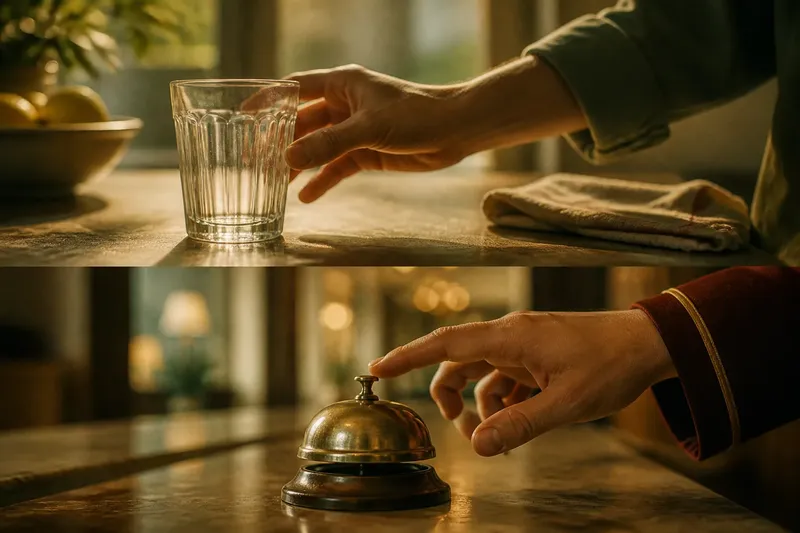
A hand reaches for a glass in one scene; in the next, a hand in another place reaches for a bell. That small echo can make a cut feel like a thought rather than a break. A match cut links shots through a shared feature, while letting their settings, characters or meanings remain distinct.
For viewers, the useful question is not simply what looks the same. It is what the resemblance asks us to connect. Here are five ways to read a match cut as both a visual rhyme and a bridge between moments.
1. Find the shared shape
A match cut may join two images because their outlines or arrangements resemble each other. A round object might give way to another round object; a face seen in profile might be followed by a similarly placed doorway. The edit draws attention to form before the viewer has time to sort out the new scene.
That resemblance is a starting point, not a claim that the objects are equivalent. A wheel and a plate can share a circle while belonging to entirely different worlds. The cut invites comparison: perhaps both suggest a cycle, or perhaps the echo is simply a clean visual handover.
Look at the screen’s larger geometry as well as the central object. Notice where the bright and dark areas fall, whether the horizon remains level, and how much empty space surrounds the subject. A match can feel strong even when the subjects differ, because the compositions preserve a similar pattern.
When watching, name the repeated shape first, then ask what the new image changes.
2. Follow the movement
Instead of matching still forms, an edit can connect gestures. A figure raises an arm, and a cut carries that upward motion into a different action; a door swings shut, then a train window slides across the frame. The movement gives the eye a path to follow over the cut.
Direction and timing matter. If motion continues in the same direction at a similar pace, the transition may feel fluid. If it reverses or stops, the interruption can become expressive: the viewer feels a shift in force, control or intention. In either case, the repeated motion does not make the actions identical. It sets them beside one another.
Say you see a dancer turn towards the left edge of the frame, followed by a wind-up toy turning the same way. The cut might make the toy seem to inherit the dancer’s energy, while the change from a person to a mechanism also introduces a colder note. The movement provides continuity; the subject change supplies the tension.
Track where the motion begins and ends, not just what moves.
3. Hear an echo
Some cuts match a sound across changing images. A repeated knock, a sustained note or the rhythm of a machine can carry the ear from one place to another. The image may change sharply, but the continuing sound gives the transition a thread.
Sound can also make a visual resemblance feel more pointed. A cut between two spinning objects may be accompanied by the same scrape or hum, encouraging the viewer to connect them. Alternatively, a sound may begin before the new image appears, preparing the change rather than announcing it after the fact.
Listen for what remains and what changes. Is the sound truly continuous, or does it only resemble the earlier one? Does it belong to the new scene, the old scene, or neither in an obvious way? Those distinctions help reveal whether the bridge is smooth, uneasy or deliberately ambiguous.
4. Read the story bridge
A match cut can link moments separated by time, place or circumstance. The shared visual or sonic feature helps the viewer carry an idea across that gap. A similar gesture might connect a character’s earlier resolve with a later decision, even if the situations differ.
The bridge may be thematic rather than explanatory. The cut can suggest a parallel between two characters without telling us that they have met, or connect a natural image with a manufactured one without making them interchangeable. The viewer is invited to hold both images in mind and consider their relation.
Context matters. A repeated shape may suggest continuity in one scene and irony in another. Ask what the first image has led you to expect, then notice how the second image confirms, complicates or refuses that expectation. The edit’s meaning comes from the relationship between the shots, not from the resemblance alone.
5. Notice the difference
The most revealing part of a match cut may be the mismatch. The images can align closely while changing scale, texture, colour or emotional tone. A smooth transition from one scene to another might therefore carry a jolt: the eye recognises a pattern just as the mind registers a new situation.
Consider the cut’s seam. Does the new shot preserve the earlier composition, then gradually disclose its difference? Does it replace a soft surface with a hard one, or a living gesture with a mechanical repeat? Such contrasts stop the match from becoming a visual puzzle with only one answer. They keep the connection open to interpretation.
This is also why a match cut does not need to be perfectly aligned to work. A slight difference in position or rhythm can make the echo feel human, uneasy or playful. The edit is not a ruler laid across two scenes; it is a choice about which likeness to notice and which difference to leave visible.
What should you look for?
How is a match cut different from a jump cut?
A match cut connects shots through a shared feature such as shape, motion or sound, often across a change of scene. A jump cut makes a noticeable discontinuity within a continuing action or setup, so the viewer feels a skip rather than a rhyme.
Does a match cut have to align objects exactly?
No. A close alignment can make the resemblance immediately legible, but movement, colour, framing or sound may provide the link instead. A looser echo can also leave room for the difference between the scenes to register.
Can a match cut connect different times?
Yes. A repeated gesture or composition can carry the viewer from one period to another without explaining every change in between. The echo offers a point of comparison, while the new setting signals that time or circumstance has shifted.
What should I notice on a first viewing?
Notice what your eye or ear follows across the edit: a contour, a direction of movement, a rhythm or a sound. Then ask what changes in the next shot, since that contrast often gives the match its story meaning.
To spot a match cut, start with the feature that survives the transition, then give equal attention to what does not. That balance makes the visual rhyme clear without mistaking it for sameness, and it reveals how a single edit can connect separate moments while keeping their differences alive.